
Table of Contents[Hide][Show]
- What Is FAI? Understanding the “Pinching” In Your Hip
- Symptoms and Complications of FAI
- Is Femoroacetabular Impingement a Long-Term Disability?
- Why Your FAI Diagnosis Alone Is Not Enough for a Disability Claim
- Building Your Case: The 3 Types of Evidence You Absolutely Need
- How to Get Your Doctor’s Support for Your FAI Disability Claim
- Tips for Proving FAI as a Disability
- Can You Get Disability for FAI with a Desk Job?
- FAI Surgery: Navigating Short-Term and Long-Term Disability
- What to Do When Your LTD Claim for FAI Is Denied
- How a Long-Term Disability Attorney Can Help
- Schedule a Free Case Evaluation Today
That deep, aching pain in your hip just won’t go away. You’ve been told it’s Femoroacetabular Impingement (FAI), and now the simplest tasks—sitting at your desk or getting out of the car—are a painful struggle. The chronic hip pain is constant, and it is making it nearly impossible to do your job effectively.
This leads to a critical question: is femoroacetabular impingement a disability that qualifies for benefits? For many people facing this condition, the answer is yes. Your long-term disability plan is designed for exactly this kind of situation, providing a crucial financial safety net when you can no longer work.
FAI is a condition where the bones of the hip are abnormally shaped, causing them to rub together and create damage over time. Long-term disability (LTD) is a type of income insurance, designed to replace a portion of your paycheck when an injury or illness stops you from working.
However, an FAI diagnosis alone isn’t enough to secure benefits. You must prove how your pain and limitations prevent you from performing your job duties. This guide outlines the steps for building a strong claim for long-term disability for femoroacetabular impingement, showing you how to document your struggle and build your case.
What Is FAI? Understanding the “Pinching” In Your Hip
The name “Femoroacetabular Impingement” (FAI) sounds complicated, but the concept is surprisingly simple. Think of your hip as a ball-and-socket joint. In a healthy hip, the ball moves smoothly inside the socket. With FAI, the ball or the socket (or both) are slightly misshapen, causing them to pinch or jam against each other during normal movements like bending or sitting. This constant friction is the source of the deep, aching pain you feel.
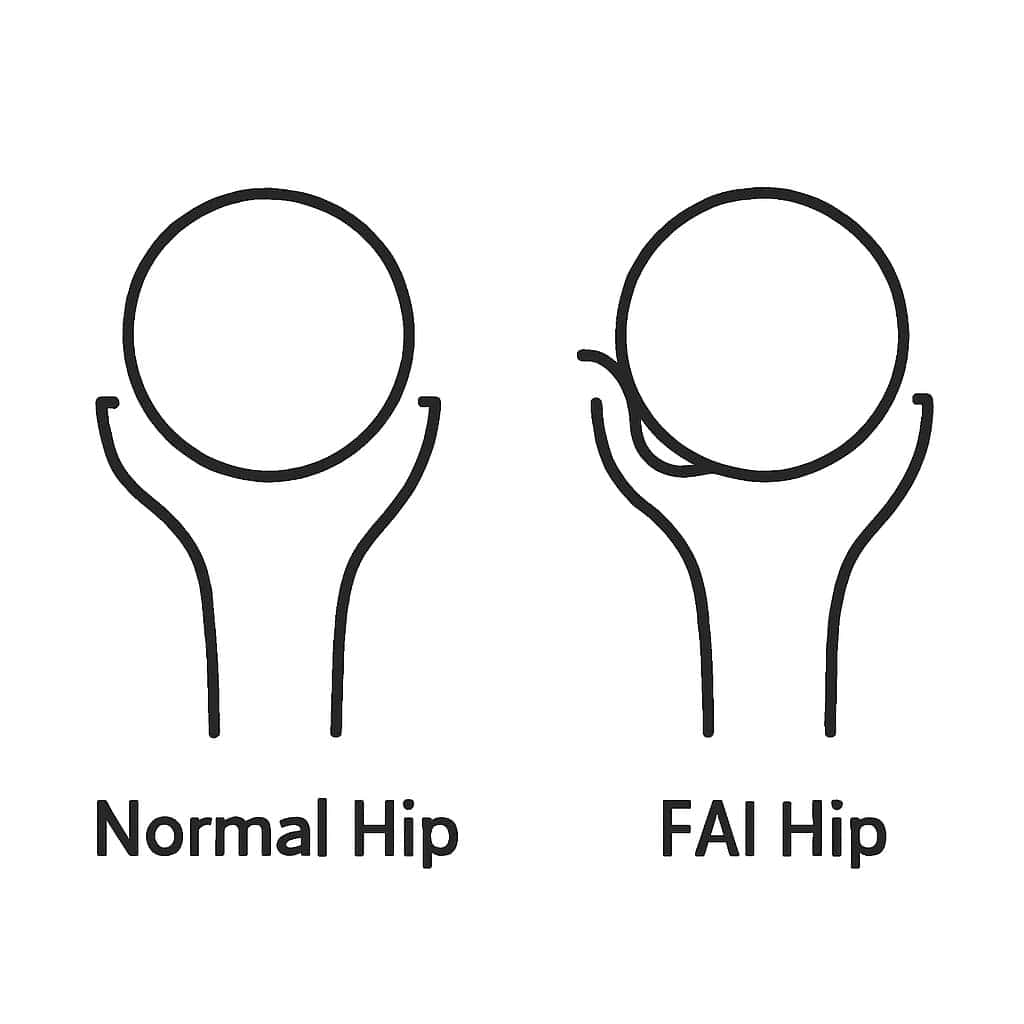
There are two main ways this mismatch happens. The first is called Cam impingement, where the “ball” part of the joint isn’t perfectly round and has an extra bump of bone. This bump grinds against the cartilage inside the socket. The second is Pincer impingement, where the “socket” has an overgrown rim that covers too much of the ball, pinching the delicate tissue in between. Many people have a combination of both types.
This repetitive pinching doesn’t just cause pain; it causes real damage. Lining the rim of your hip socket is a ring of soft cartilage called the labrum, which acts like a gasket to seal the joint. Over time, the grinding from FAI can fray, shred, and eventually tear this gasket. This is a hip labral tear, a common and painful injury that often happens as a direct result of untreated FAI.
The pain and stiffness from the bone-on-bone friction and a resulting labral tear are classic FAI symptoms. This physical damage is not just in your head—it’s a mechanical problem that directly limits your ability to move, sit, and stand without pain.
Symptoms and Complications of FAI
Symptoms of FAI can vary widely, but they commonly include:
- Pain in the groin or hip, especially with activities such as bending, sitting, or walking.
- Restricted range of motion in the hip joint.
- Stiffness or a “catching” sensation in the hip.
- Pain radiating into the thigh or buttock.
If left untreated, FAI can lead to joint damage over time, including labral tears and cartilage deterioration, ultimately increasing the risk of hip osteoarthritis.
Is Femoroacetabular Impingement a Long-Term Disability?
FAI can be disabling if pain and movement limitations prevent sustained work activity. Whether it qualifies for long-term disability insurance benefits depends on the policy’s definition of disability, but chronic FAI that limits mobility and prevents work tasks may qualify. Medical documentation to support the claim is critical.
Why Your FAI Diagnosis Alone Is Not Enough for a Disability Claim
You’ve done the hard part: you’ve seen doctors and finally have a name for your pain—Femoroacetabular Impingement. It’s natural to think this diagnosis is the key to your disability claim. However, this is one of the most common and critical misunderstandings when filing for long-term disability. Insurance companies operate on a simple principle: a diagnosis is just a label, not proof of disability.
The insurer’s main question isn’t what condition you have, but what that condition prevents you from doing. Think of it this way: some people with FAI can manage an office job with modifications, while for others, the pain makes sitting for even an hour impossible. This is why knowing how to prove FAI prevents working is more important than the diagnosis itself. You must show them that because of the pain, you can no longer perform the specific duties of your occupation.
Winning a disability claim isn’t about having the FAI diagnosis in your medical records. It’s about documenting your functional limitations. Your success hinges on your ability to provide clear, consistent evidence that demonstrates your work limitations due to FAI pain. This evidence is what translates your daily struggle into a language the insurance company understands and is required to act on.
Building Your Case: The 3 Types of Evidence You Absolutely Need
If the diagnosis alone isn’t enough, what is? The key is to gather different types of proof that, together, paint a clear and undeniable picture of your daily struggle. The medical evidence needed for your hip impingement claim isn’t just one document; it’s a file you build piece by piece to show how your FAI symptoms are affecting your ability to work.
Your claim’s strength relies on three types of evidence:
- Objective Medical Evidence: This is the hard proof of your hip condition that an insurance adjuster can see on paper. It includes imaging like X-rays or, more importantly, an MRI that clearly shows the bone spurs of FAI and any resulting damage, such as a labral tear.
- Consistent Treatment History: These records show you are actively trying to manage your condition. It’s a paper trail of your visits to the orthopedist, physical therapy sessions, pain management appointments, and any attempted treatments like injections.
- Your Personal Symptom & Limitation Journal: This journal connects your diagnosis to your real life. In a simple notebook, track your pain levels daily. More importantly, write down specific things you can no longer do. For example: “Tried to sit through a one-hour meeting but had to stand up after 20 minutes due to sharp groin pain.” This turns a medical fact into a clear, work-related limitation.
Together, these documents create a powerful narrative. Your MRI shows why you have pain, your treatment records show you’re doing everything you can, and your journal shows how it all prevents you from doing your job.
How to Get Your Doctor’s Support for Your FAI Disability Claim
Your doctor is your most important ally in this process, but they need your help. While they understand your FAI, they don’t know the specific physical demands of your job or what the insurance company requires. Simply telling them, “I can’t work anymore,” won’t be enough to get the detailed support you need for your claim.
Instead of asking for a generic note, you must guide the conversation toward your functional limitations. The most effective way to do this is by bringing a copy of your job description and your symptom journal to your next appointment. This gives your doctor the concrete details they need to write a powerful statement on your behalf.
For instance, you can point to your job description and say, “It says here I need to lift 25-pound boxes, but I can’t even lift a bag of groceries without sharp pain.” Or, “My job is 90% sitting, but as you can see from my journal, I can’t sit for more than 30 minutes at a time without pain.” This directly connects the medical evidence needed for your hip impingement claim to your inability to work.
Ultimately, your doctor will likely fill out a detailed disability form from the insurance company, often called an Attending Physician Statement. Their answers are critical. By providing them with clear, work-related examples, you help them accurately explain why you can no longer do your job—even one that seems less physically demanding, like a desk job.
Tips for Proving FAI as a Disability
- Comprehensive Medical Records: Detailed records from orthopedic evaluations, imaging studies (such as X-rays, MRIs, or CT scans), and any physical therapy documentation are essential. The more specific the evidence of joint damage or limitations, the stronger the claim.
- Functional Capacity Evaluations (FCE): An FCE evaluates your ability to perform work-related activities. Documentation of limitations, such as an inability to sit, stand, or walk for long periods of time, is particularly helpful in proving physical limitations.
- Residual Functional Capacity (RFC) Form: An RFC form completed by your doctor can outline the specific ways in which FAI affects your daily functioning, providing important information for claims evaluators.
Can You Get Disability for FAI with a Desk Job?
Many people believe that disability benefits are only for those with physically demanding jobs. An insurance company might even argue that since your role is “sedentary,” your hip impingement shouldn’t prevent you from working. This is a frustrating and common myth. For those with FAI, the act of sitting itself can be the most painful trigger, making a standard eight-hour desk job an impossible task. The constant pressure and specific hip angle required for sitting often directly aggravate the condition, leading to severe pain and an inability to concentrate.
This inability to remain seated is often called “sitting intolerance,” and it’s a critical part of a successful disability claim for FAI. The key is to prove that you cannot stay in one position long enough to be a productive employee. In the same symptom journal your doctor found useful, start documenting this specifically. Note exactly how long you can sit before the pain forces you to stand up, stretch, or walk around. An entry like, “Had to get up from my desk after 25 minutes due to deep aching in my groin,” is far more powerful than just saying “my hip hurt at work.”
This kind of detailed evidence directly counters an insurer’s argument that you can perform a desk job. No employer expects an employee to be on their feet and away from their workstation every half hour. By showing that your FAI symptoms prevent you from sitting for sustained periods, you prove that you cannot reliably perform the duties of any sedentary job.
FAI Surgery: Navigating Short-Term and Long-Term Disability
If your FAI requires surgery, such as an arthroscopy or even a future hip replacement, you’ll obviously need time off work to recover. This is where short-term disability (STD) often comes in. Most employer-sponsored plans offer STD to replace a portion of your income for a limited time, typically three to six months, while you heal from a medical event.
However, your long-term disability benefits won’t begin the moment your STD runs out. Every LTD policy includes something called an elimination period. Think of it like the deductible on your car insurance; it’s a waiting period you must get through while continuously disabled before your LTD payments can start. This period is most often 90 or 180 days.
Short-term and long-term disability for FAI surgery are designed to work together. Your STD benefits are meant to provide an income bridge, covering your bills during that LTD elimination period. In an ideal scenario, as your STD benefits are about to end, your approved LTD benefits would begin seamlessly.
Crucially, this transition from STD to LTD is almost never automatic. You must actively apply for your LTD benefits, usually while you are still receiving STD payments. Don’t wait until the last minute. If your recovery is taking longer than anticipated and you cannot return to your job, you need to start the LTD application process early. Unfortunately, even with perfect preparation, insurance companies can still issue a denial.
What to Do When Your LTD Claim for FAI Is Denied
Receiving a denial letter for your FAI disability claim can feel like a punch to the gut. After all the paperwork and waiting, a “no” from the insurance company is disheartening. But it is crucial to understand that this is not the end of the road. An initial LTD denial for an FAI claim is incredibly common and should be treated as a predictable step in the process, not a final failure.
The denial triggers the start of the appeal process. This is your formal opportunity to challenge the insurance company’s decision. More importantly, this administrative appeal is your single best chance to strengthen your case by adding new medical evidence, vocational reports, and personal statements that prove how FAI limits your ability to function in the workplace. It’s where you build the foundation for winning your benefits.
Before you do anything else, you must take one immediate action: find your appeal deadline. Buried within your denial letter, the insurer is required to state the exact date by which you must file your appeal, which is typically 180 days. This is not a suggestion. Missing this deadline can permanently disqualify you from receiving any benefits for your claim.
Once you know your deadline, you can begin to form a plan. The LTD denial for FAI appeal process is complex and has strict rules, which is why many people seek guidance from a disability lawyer for hip conditions at this stage. They can help you gather the right evidence to prove your LTD case, a process that is also vital for any separate claim for Social Security Disability for hip impingement.
How a Long-Term Disability Attorney Can Help
Navigating an FAI-related disability claim can be complex, especially when symptoms are initially manageable but worsen over time. If your claim is denied, an attorney can also help you navigate the appeals process and ensure that your rights are protected throughout.
Working with a national disability attorney like Nick Ortiz and the experienced legal team at the Ortiz Law Firm can help you effectively gather evidence, clarify policy terms, and present a compelling appeal to the insurance company.
Schedule a Free Case Evaluation Today
The impact of FAI on your ability to work can be profound, so if you are struggling to get the benefits you deserve, seeking experienced legal advice can make a significant difference in the outcome of your case. Contact us online or call us at (888) 321-8131 to schedule a free case evaluation.
Sources
Yale Medicine. “Femoroacetabular Impingement Syndrome.” Retrieved from: https://www.yalemedicine.org/conditions/femoroacetabular-impingement-syndrome Accessed on November 19, 2024
